A couple years ago I wrote and posted a couple of essays about growth-centered story structures. Growth-centered story structures have existed for a long time, but have been ignored or forgotten in the emphasis on the conflict-centered 5-act story structure.
If you haven’t yet, you should definitely check out Worldwide Story Structures by Kim Yoonmi. It’s a wonderful introduction to the variety of story structures around the world, and will really help you begin to understand the full palette available to us as writers, beyond the 5-act plot.
My own growth-centered story structure is the result of trial and error over about a decade, as I jettisoned the centrality of conflicted and focused on writing the kind of stories I wanted, regardless of if they were ‘right’. Everything I write about my story structure is me trying to describe something no one has ever described before, and which may not have existed before I created it.
When I wrote the previous essays, I was just beginning to analyze and understand how my stories, and other growth-centered writing, work. I wouldn’t say I’ve figured it out yet, but I’m definitely getting a better handle on things.
With that in mind, one thing I’ve figured out is a better way of describing and understanding how my particular kind of growth-centered plot works.
So let’s take a look at it.
Cyclical Growth Plot
Here I am borrowing Kim Yoonmi’s format for analyzing a plot structure.
My plot structure is a cyclical one. There are six stages to it, with three stages making up the central cycle.
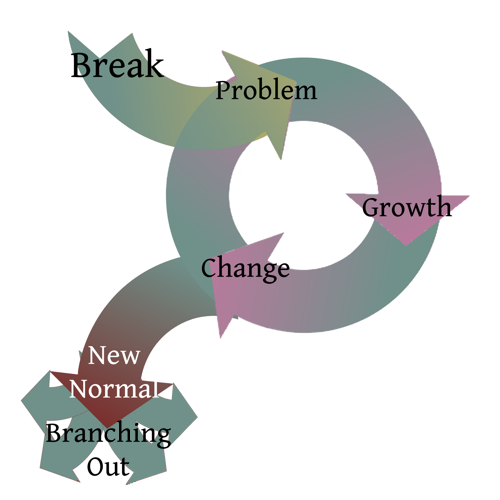
Number of Acts: As many as needed
What is it?:
- Break with Normality
- Problem the characters can’t/don’t know how to deal with
- Growth
- Change in the situation/characters understanding of the situation
- repeat 2-4 as necessary until
- New Normal
- Branching out to help others grow
Story Driver(s): ?
Notes:
Some stories have a ‘central conflict’ in the sense that an outside force creates the ‘Break with Normality’ and continues to interfere in establishing a new normal. However a central conflict is not necessary. If one does exist, it may be resolved before, during, or after the establishment of a new normal. Or not resolve at all.
The Break
The first stage is the Break with Normality. Before the break, characters existed in a situation they have considered ‘Normal’. ‘Normal’ usually has some built in stability or homeostasis so characters know what to expect and how to deal with the situations they run into.
‘Normal’ isn’t necessarily a good or healthy situation. In Bound by His Oath, ‘Normal’ for Mildthryth was being under frequent attack by lordlings who sought to conquer her lands and force her into marriage. ‘Normal’ for Reimund was being one of those lordlings. In the upcoming A Smear of Blood, ‘Normal’ is the goddes and Called slowly dying out under the oppression of the monks. But ‘Normal’ can be a healthy, happy situation — at the beginning of Planting Life in a Dying City, ‘Normal is Lefeng looking forward to traveling with the family ey loves and eir upcoming marriage.
How do we define ‘Normal’ then? ‘Normal’ is a (more or less) straight line trajectory. The characters’ lives are moving in a certain direction and are expected to continue moving that way.
The Break creates a sudden change in trajectory, wrenching characters lives in a new direction.
There are several ways a Break can happen. A character may make a choice that creates a Break, as when Mildthryth chooses to offer vassalage and marriage to Reimund rather than trying to ransom him, creating the possibility for a new relationship. It may be chance, like in Planting Life in a Dying City, when the tsunami destroys Lefeng’s family and village. It may be that a character from outside ‘Normal’ enters the story — as Iberto does in A Smear of Blood when he literally crashes into the high altar.
Whatever it is that causes the Break, there is a clear before and after.
A Problem
If the before is ‘the Normal’ then the after is ‘a Problem.’
A Problem is a situation that the characters need to deal with and don’t know how to. A Problem may be a new problem, an old problem the characters have a new perspective on, or an existing problem that is new to these characters.
A Problem is the first stage of the cyclical part of the story. Which is why it is ‘A’ Problem and not ‘The’ Problem. There will be multiple Problems throughout the course of the story.
The existence of multiple Problems is the biggest difference between a Problem and the ‘Conflict’ in a conflict-centered story. Many (though not necessarily all) Problems /are/ conflicts. But in a conflict-centered story there is a single central conflict. In a cyclical growth-centered story there are many not-central Problems.
The first problem in Bound by His Oath is that if Reimund accepts Mildthryth’s offer, he will shame himself. This is a new problem, as during the Normal, he was a proud man who refused to act in a way he would consider shameful.
In A Smear of Blood, the first problem is that there are not enough priests. Specifically, it is Iberto realizing that there are not enough priests. There have not been enough priests for a very long time before Iberto arrived at the temple. The lack of priests was a key part of the Normal, in fact. What has changed is not the problem itself, but that after the Break Iberto can see the problem.
The most important thing about a Problem is that the characters existing way of dealing with things won’t work to fix it. Reimund cannot automatically reject the shame — not unless he is willing to condemn his friends and followers. Iberto has no idea how to even begin fixing the lack of priests. If the characters attempt to continue doing things the same way they always have, the problem will continue or get worse.
Growth
If the characters want to deal with their problem, they need to grow. They may grow emotionally in some fashion, learn a new technique or skill, or if it is an ensemble story the main characters may grow in numbers, recruiting new members or allies to fight with them. There are probably dozens of ways a character can grow in response to a Problem.
Reimund, in Bound by His Oath, grows emotionally when he chooses to accept the shame for the sake of his men. This resolves the current Problem and he and Mildthryth are able to move forward together.
Importantly, Growth is a response to a Problem, not necessarily a fix for it. In A Smear of Blood, Iberto had been content to train for his new role and do his goddess’ bidding. On learning about the lack of priests and how it affects the goddes, Iberto stops being passive. He makes the decision to act — to hunt down the reason for the lack of priests and do something about it.
This is Growth, but it is not Growth that will immediately fix the problem. The problem will remain and Iberto and his friends and allies will spend most of the story addressing it in one way or another. That’s okay.
If Growth doesn’t fix a Problem, what’s its purpose in the story? Well, Growth leads to Change.
A Change
A Change is the new situation the characters find themselves in after after they grow. The last time I wrote about my story structure I called this stage ‘temporary stability.’ I’ve changed it because whether or not the situation is stable for any period of time has more to do with how fast the story is moving than the way the plot develops.
Like Growth, a Change can take several different forms.
In Bound by His Oath, after Reimund swears his loyalty to Mildthryth, she and all her people stop treating him as a prisoner and begin treating him as her betrothed. This is a Change in how the characters interact with each other.
Iberto, in A Smear of Blood, sees a different kind of change. Because he sets himself his own hunt for the first time, he begins to learn things. Most importantly, he learns that the monks are actively working against the goddes. This is a Change in perspective. A Change in how he understands the situation he finds himself in.
For Iberto, this leads to a new Problem, or new understanding of an old problem — there are not enough priests because potential priests aren’t coming to the temple where they can be recruited.
The Cycle
For a while, each Change will lead to a new Problem. Which leads to more Growth, another Change, a new Problem, etc.
The relationship in Bound by His Oath faces another problem when Reimund refuses to accept his new position and seeks to undermine Mildthryth, this leads to more growth, more change, more problems. Each turn of the cycle sees the characters and their situation growing/changing further and further from their original Normal.
A New Normal
Eventually, a Change will come with doesn’t lead to a new Problem. The characters and situation have changed enough, grown enough, that whatever problems they are facing are no long a Problem – that is, the characters have learned how to cope with and/or fix these problems and no longer NEED to grow in order to cope with them. The cycle is broken. The characters settle into a New Normal. Their lives are moving in a different direction then they were before the Break, but they are again moving ‘forward’ in a stable fashion.
This doesn’t necessarily mean that all their problems are solved. Life doesn’t work that way, and stories don’t need to either. What it means is that the characters have grown enough, and the situation has changed enough, that the characters are confident in their ability to handle the problems they are facing.
Branching Out
Characters who have grown to the point of being secure in a New Normal and who care about other people will want to spread that security. The final point of our story is the beginning of someone else’s story — when the characters reach out to help other characters. Sometimes that help will Break the other character’s Normal, it might provide guidance or resources for someone else’s Growth or Change, or something else.
Branching Out will usually come at the end of the story, but sometimes, for various reasons, it may come earlier. Planting Life in a Dying City is broken into six parts, one part focusing on each of the main characters. In the second part, the character Tsouchm instigates the Branching Out after one of eir Growth stages. Tsouchm’s life has improved considerably in the early part of eir story section, and ey wants to share that improvement with eir old friends, a desire the other family members support and aid.
So Far, It All Fits
I previously said that there are four things that make a growth-centered story:
- The plot can be defined in terms of growth.
- The story cannot happen without significant character growth.
- The story doesn’t need an antagonist, and if there is one the protagonists are not focused on them.
- The protagonist’s growth and actions affect the world around them/the wider community.
What I’ve outlined here for my growth-centered plot structure includes all four. Well, at least three of the four. We didn’t really talk about characters at all. The lack of an necessary antagonist can probably be inferred from the story structure, but I didn’t actually address point three here.
Next week, I’ll share some of my thoughts on characters in a cyclical growth-centered story and take a closer look at point three.