Welcome!

I’m Jess Mahler, and welcome to my home on the web.

As an author, I explore the breadth & boundaries of intimate relationships through unique speculative fiction worlds. Sweet, sexual or platonic, my stories are always queer, frequently polyamorous & sometimes kinky. No AI.

Here you will find information about my stories, my thoughts on writing, and other random things.

Why Centering Growth?

Ever since I wrote the text for Centering Growth (which used to be on my home page), I’ve been having second (and third, and fourth) thoughts. I see around me every day people causing harm by ‘centering’ certain types of growth. Streaming services expecting unlimited growth in views and viewers, venture capitalists pursuing unlimited growth in profits, empires seeking unlimited growth of power and influence. I also see how the drive for unlimited growth (of converts, of power, of borders) fueled the conflict-centered worldview that I turned to growth to /avoid/.

I considered removing the page. Maybe talk about the cycles that growth is part of, homeodynamics, that sort of thing. It didn’t work, didn’t fit. Growth, for me, is central. Central to my life and central to my writing.

It is, I think, a different kind of growth. Not a growth that can be measured with metrics, plotted on graphs, or translated to profits. And it is a growth that is necessary.

I spent more than half my life like a bonsai tree: trapped in a too-small space, twisted to grow in the direction and shape others chose. Worse, because an experienced bonsai grower works with the tree, they don’t force growth with no consideration or respect for the tree’s nature and needs.

I spent more than half my life being told that my stories needed more conflict. Conflict for the sake of conflict. Because it’s not a story without conflict.

Why center growth?

Because I am reclaiming it.

I am sinking my roots deep into the earth, spreading my branches wide. I am saying to hell with conflict and their fucked up definition of ‘story’. I am creating my own stories, where conflict isn’t part of the definition and characters grow, like I grow, simply because growth is beautiful. Simply because we deserve the chance to be better. To be us.

That is why I am centering growth.

Where to Buy Books Other than Amazon

A few years back I had a habit of every six months or so doing a thread on Fedi about options for getting books other than Amazon. Eventually it finally occurred to me that I could write it once, put it up on website, and update as needed, rather than constantly reinventing the wheel.

Here’s the updated version for the new site.

Couple of notes before we get started:

This is geared towards US book sellers. I just don’t know much about book sellers in other countries. If you know any others please leave them in the comments.

Many folks aren’t aware that Goodreads is owned by Amazon (as, of course, is Audible, and anything with ‘Kindle’ in the branding). The focus here is ebooks, but we’ll also talk a bit about audio books, Goodreads alternatives, and anything else I can squeeze in.

Ebooks:

Authors website — some authors have a webstore where you can buy their books. Bonus: Author gets more money

Publishers website — ditto, without the bonus

Smashwords — support indie authors!

Your Local Bookstore — some indie book stores have ebook sales. (Don’t know any local book stores? Find one on Indie Bound)

Someone’s Local Bookstore — if your local book store doesn’t, you can find a list of other local book stores that do through Indiebound (downside, must use the My Must Reads app)

DriveThruFiction — lots of indie and oddball stuff

Kobo — will give a percentage to your local book store (or someone else’s local bookstore) downside: DRM-locked books can only be read in app or the Kobo e-reader, some books now readable in browser

Google books — yeah, it’s Google. But when it comes to books, google is the lesser of two evils. Many of the same problems as Kobo, but all DRM-locked books can be read in browser

Avoid

Barnes & Noble — their DRM thing won’t let you read your books if you don’t have an active credit card on file

Amazon (of course)

Pulp Books:

Your Local Bookstore

Authors website — some authors have a webstore where you can buy their books. Bonus: Author gets more money

Publishers website — ditto, without the bonus

Someone’s Local Bookstore — Book Bound will let you pick a local store to shop from

Thrift Books — great for used books of all types

Avoid

ABEBooks (It’s owned by Amazon)

Amazon (of course)

Walmart (it’s Walmart)

Audio Books

Librevox — free audio versions of books in the public domain

Libro.fm — subscription service similar to Audible, but you can download actual MP3 files

Chirp — really good sales

Avoid

Audible (owned by Amazon)

KU Alternatives

Everand — monthly subscription to thousands of ebooks, audio books, magazines, and more. BONUS! Many KU ebooks are available on Everand as audiobooks so you can leave KU and still read stuff from some of your fave authors.

Your Local Library — Go old fashioned! Paper books, ebooks, and audio books for free!

Kobo Plus

24Symbols

Goodreads Alternatives

(Yeah, Amazon owns Goodreads)

Storygraph

Bookwyrm

LibraryThing (better for institutions than individuals, but some folks make it work)

Where I Buy Books

My book buying priorities are:

I want DRM free ebooks in .epub format

I want the author to be paid as much as possible

So the first place I look is on the authors website.

Many authors have their on webstores these days. Those webstores almost always offer DRM free epub, and if I’m buying from the website I know that the ‘retailers cut’ on an sale is ALSO going to the author.

My next stop is the publishers webstore (if there is a publisher who has a webstore. Most of them don’t, but a few do.)

If neither the author nor publisher have a webstore, my next stops (in order) are:

Smashwords

Google Books

Kobo

Used bookstores for paper copies

I prefer to buy ebooks because they are cheaper and I’m less likely to lose them if my family becomes homeless again. The cheaper is not the biggest factor these days, which is why used bookstore is the last spot on the list. Authors don’t get a percentage when I buy used books, and I want them to get paid. So even though used books are cheaper than ebooks, I go for ebooks first.

I also have an Everand account and (of course) Overdrive through my library.

Community Suggestions

Stuff other folks have suggested that will be added to the main article in the next update:

Bookshop.org

Waterstones – UK

Blackwell’s – UK w/ international shipping

Better World Books – Used

eBay – Used

Pluto Press – UK

Kenny’s Bookshop — Ireland

Standard Ebooks — public domain ebooks

Project Gutenberg — public domain ebooks

Alibris — US and UK with international shipping

What Makes a Growth Centered Story?

Growth-centered stories are a relatively new idea for me, and I’m still exploring all the different facets of what they are and how they work. Today I want to explore what makes a growth-centered story and how it’s different from other stories.

So today, we’re going to take a look at that.

As always, I’m figuring this out as I go and I’m sure I’m missing some stuff.

For this discussion, I’m using Andre Norton’s Hands of Lyr as an example. The Hands of Lyr and the other Senses stories have a central conflict which is critical to the plot. But the stories are not centered on that conflict; they are centered on growth. As a story that walks the line between conflict- and growth-centered, I think The Hands of Lyr is a good choice to identify what makes a growth-centered story and how it is different from conflict-centered even when there is significant conflict. Expect major spoilers.

Several things make up a growth-centered story. Here’s my current take (subject to evolution and change):

  1. The plot can be defined in terms of growth.
  2. The story cannot happen without significant character growth.
  3. The story doesn’t need an antagonist, and if there is one the protagonists are not focused on them.
  4. The protagonist’s growth and actions affect the world around them/the wider community.

Destroy the Binary — it’s not just growth or conflict

I’m focusing on the line between growth and conflict-centered stories because most English stories are conflict-centered. But not all stories are one or the other. I mentioned in another essay LeGuin’s story Those Who Walk Away from Omelas as a Carrier Bag story that is not growth-centered. In fact, it rejects even the idea of growth, pointedly saying that none of the characters seek or achieve change. They only either accept or reject the horror their seeming utopia hides.

Defining the Plot — the one line summary

The first requirement of a growth-centered story is that the story can be defined in terms of growth. The one-line summary is probably the most common way to define a plot.

If Andre Norton used one-line summaries for her stories, I’ve never seen them. But if I were to write a logline for The Hands of Lyr, it would go something like this:

A priestess-in-training and a priest-hating warrior must learn to work together to find and restore a sacred relic and save a broken land.

There are several other ways you could put together a one-line summary. Still, I can’t think of any I’d write that doesn’t include the need for Alnosha and Kryn to learn to work together. Learning to work together is a form of growth.

So, this story can be defined in terms of growth.

Now, it is possible to define this story in terms of conflict. For instance:

A priestess-in-training and an embittered warrior must work together to defeat an ancient evil poisoning the land.

This summary is less accurate (and we’ll see why later), but it’s a workable summary for this story.

Some growth stories can be defined in terms of conflict, but that doesn’t make them not growth-centered. The important thing is that they /can/ be defined — accurately — in terms of growth.

The Story Cannot Happen without Significant Character Growth

This… almost goes without saying, right? You can’t have a growth-centered story without growth. This growth may take different forms, but it has to be there.

It Does Not Need an Antagonist

Many growth-centered stories don’t have an antagonist or a central conflict to overcome. Instead, they may have a series of small conflicts the protagonist must navigate or have other types of challenges.

If there is an antagonist —

The Protagonist Is Not Focused on the Antagonist

Just because there is an antagonist doesn’t mean that the protagonist is focused on them. Sometimes, you have a “I am your greatest rival!” “I didn’t know I had a rival” moment. The antagonist is obsessed with the protagonist, and the protagonist just… didn’t know they existed. Or they might know about the antagonist but consider the antagonist a ‘later’ problem while they try to focus on this other thing.

Or, as in The Hands of Lyr, the antagonist may be interfering with another quest.

Nosh’s goal in The Hands of Lyr is to reassemble the titular Hands of her goddess. Kryn gets dragged into her quest, initially unwillingly. This quest is a threat to the antagonist — the evil wizard who broke the Hands nearly a century ago. Having the Hands reassembled will be a major threat to his power in the world. But —

If the evil wizard got struck with lightning a few chapters into the book, the story would still have happened and had the same basic plot.

Nosh and Kryn would still have traveled across the land seeking the scattered Fingers. They still would have faced raiders, criminal lords, and blizzards. Kryn would still have needed to confront himself and his goals and accept that he had become a new person and his old goals did not fit the person he became. Nosh would still need to learn how to interact with people and function in society after being raised in total isolation by the last priestess of Lyr.

Now, the evil wizard doesn’t get hit by lightning a few chapters in. He is a threat throughout the entire story up until the final confrontation. But the main characters, when they become aware of him, are aware of him not as the goal but as an /impediment/ to restoring the Hands and, with them, the land once ruled by Lyr.

Even in the final confrontation, we see this. When Nosh and Kryn reach the statue, they find the evil wizard left a spell which threatens the Hands and the wizard himself slowly manifesting in the room.

Instead of a big climactic battle, Nosh /ignores/ him. That’s her big challenge: ignoring the big bad and his threatening magic while she restores the fingers. To trust in herself, her goddess, and Kryn at her back. And Kryn, who does confronts the evil wizard, defeats the big bad not by attacking /him/, but by attacking the magic cord that ties him to the spell.

The evil wizard is, as far as the world is concerned, the big bad. He broke the world, destroyed the old order, and laid waste to entire countries. But as an antagonist, he is a distraction. It is by not being drawn into a confrontation that Nosh and Kryn win the day — because the wizard may fill the role of an antagonist, but he is not their focus.

Their focus is on healing and restoration, not conflict.

The Protagonist’s Growth and Actions Impact the Wider Community (Maybe)

I’m not sure about this one, but it’s a pattern I am seeing. Growth-centered stories generally focus on the growth of the protagonist, but growth does not happen in isolation. The growth of the protagonist will impact the world around them. If all change is internal, it is not true growth.


It’s been over six months since I first wrote this and posted it on my old website. Maybe over a year, I kind of lost track in there. Reading it over now, I’m pretty happy with it. I think this is a good litmus test for what is and is not a growth-centered story.

What do you think? Drop a comment and let me know!

Growth-Centered Story Structures

  1. Growth Centered Story-Structure
  2. What Makes a Growth Centered Story?
  3. My Cyclical Growth-Centered Story Structure
What Is Harm?

I was drafting a ‘Teshuva procedure’ (the traditional Jewish version of a ‘restorative justice process’) for my synagogue when I ran into a small problem. How could I define the situations the procedure was designed to address and the types it wasn’t. Easy to say ‘harm and harassment,’ but what is harm?

For all the discourse around harm reduction, restorative justice, etc., I realized that I’ve never seen anyone talking about this important question. What is harm?

How do we define it?

Many people in leftist spaces have defaulted to an ‘I know it when I see it’ view of harm. Which anyone familiar with history knows won’t work as a practical definition. It inevitably ends up as a silencing and oppression tactic. After all, if I know harm when I see it and I don’t recognize harm being done to people I see as ‘other’… at best, I don’t have power over them, and they will need to argue for recognition of the harm they have experienced. At worst, I have do power over them and can silence them directly.

Another popular approach (not just in leftist spaces) is to self-define harm. If someone says they are harmed, then they are harmed. This sounds like a fine system — until someone says that your existence makes them uncomfortable and you are harming them by existing. Suddenly, it doesn’t seem like a very workable definition.

Other discussions are happening now, discussions that talk around the question ‘what is harm.’ This discussion on Tumblr, for instance, talks about the problems with equating ‘uncomfortable’ with ‘harm’. If you stare out of the corner of your eye, you can see the fuzzy edges of other definitions taking form.

But as an autistic person, I have been burned by these kinds of fuzzy, not-defined-but-understood social weirdnesses before. I really dislike this way of defining a thing.

I want to see actual discourse. What is harm? What does it mean when we say someone or some group has been harmed? Is all harm the same?

What Is Harm?

We’ll never going to come up with a perfect definition of ‘harm.’ Language is not only ever-evolving but inherently imprecise. That doesn’t mean we can’t try for a good-enough definition.

No one person will be able to come up with a good-enough definition on their own. We need to see lots of discussion and debate to reach a comprehensive, widely applicable definition.

(Let me acknowledge here that I’m sure these discussions have been happening in scholarly circles. But those discussions and definitions haven’t filtered out into mainstream use, which is where they are needed.)

But I’ll put in my two bits and see if anyone wants to riff off them:

‘Harm’ is action that interferes with or prevents full access to personal autonomy or public spaces.

  1. If someone breaks my leg, then both my personal autonomy (ability to choose where to go and when, financial autonomy [paying for medical bills], etc) and my access to many public spaces are restricted. If the TSA takes away someone’s mobility device, their personal autonomy (ability to choose where to go and when etc) and access to public spaces are restricted. Both of these are harm – even if my leg will heal and the mobility device will (hopefully) be returned.
  2. Harm must be an action (including speech actions). It cannot be thought, idea, or intention. However, intention to harm can be an ethical violation in and of itself, even if no harm is caused.
  3. Harm can be accidental or even done without awareness of causing harm.
  4. Any entity can cause harm – who takes the action is not part of the definition and should not be.
  5. Preventing access to other people’s private spaces (without other consequences) is not harm. I do not harm you by blocking you from my blog or not letting you in my home.
  6. Harm is not always unethical. A dentist pulling my tooth is harming me (pain bad enough to interfere with daily life, restrictions on eating, potential long-term dental issues). But if my tooth is damaged enough then the harm of pulling it may be necessary to protect my long-term health. If someone attacks me and I punch them to defend myself, I have harmed them. But they would not have been harmed if they had not acted with intent to harm me first.
  7. Harm can be consented to. I can consent to having my tooth pulled, to ‘extreme’ sports, to kink without safe words, etc. This consent (like all consent) can be withdrawn.

What do you think?

How would you modify this definition?

Or what alternative definition would you propose?

This definition fails to address some harm beyond the individual level. What about ‘harm to the environment’ or ‘harm to the community’? Or broad-scale harms like cultural appropriation. I have no idea how to fix this, do you?

Walking Away from the ‘Zon

On January 1st, 2026, I will be unpublishing all my fiction ebooks from Kindle Direct Publishing. If you have been interested in my books and prefer to buy from Amazon, now’s the time to get them before they are gone.

That said, I’d prefer you didn’t. All of my stuff is available through other retailers, including Smashwords, where you can download a clean epub or mobi file and upload it to your Kindle. (Smashwords End of Year Sale is going right now, so you can even get my books at a discount there if you buy now.)

Unfortunately, I know my leaving the Zon — that many authors leaving the Zon — is not going to have any impact. Amazon has proven time and time again they simply don’t care about authors. What will make a difference — the only thing that will make a difference — is if readers start leaving Amazon in large numbers.

I’m asking you today to consider doing just that.

Why You Should Leave Amazon

  1. You don’t own your books — I’m far from the first to point this out, and I won’t be the last. But with Amazon all you are buying is a license to read the book. A license that can be revoked at any time, with no warning. More than one person has logged onto to Kindle to find a favorite books just… gone.
  2. Amazon is an evil corporation with a capital ‘E’ — Do I really need to go into this one? From the way they treat their workers, to how they have withheld royalties to authors, to their ‘Kindle U’ walled garden meant to make them an ebook monopoly, to so many other things, Amazon is evil. We know this. It’s time to act on it.
  3. Amazon is a reader trap — I’ve talked before about how Amazon is an author trap. It’s also a reader trap. It uses a variety of tools to create the illusion that you have to buy from them, that you don’t have choices. You do, don’t let anyone take them from you.

You Can Save Your Library

One big reason people give for not leaving Amazon is they already have so many books there they don’t want to lose. In other words, sunk cost fallacy.

First off, just because you start buying books elsewhere doesn’t mean you’ll lose access to your Kindle books. You can keep reading you Kindle books as long as Amazon doesn’t fuck you over.

But you also don’t need to let Amazon hold your books hostage. There are ways to jailbreak your Kindle books. These may not be available to everyone, but they should be an option for most folks.

I managed to download and save my Kindle ebooks years ago using Calibre. You can still do that, though it’s a bit more of a hassle thanks to Amazon’s perpetual updates. Here’s a guide to two ways to get your Amazon ebooks that still work last I heard. Both require Calibre, which is a free ebook library organizer.

You Can Get Books Lots of Places

There was a time when Amazon was one of the only places to get ebooks, but that time is long gone. In fact, there are good alternatives to Audible and KU now as well.

Check out Where to Buy Books Other than Amazon to get started!

The Value of Walking Away

The last few years I’ve tried to always have a nonfiction book going. Since I learned that I can handle nonfic in audio way better than one print, I’ve done more nonfic reading in two years than in the prior decade. And I’ve learned a lot along the way.

Today is only the second time I’ve DNF’d one of my nonfic audio reads.

The first book I DNF’d, The Story of Work, was a disappointment, but didn’t bother me. I picked up a couple of really bad errors in the authors discussion of ‘work’ among hunter-gatherers, and it read like he was using those same errors to set up a men’s work vs women’s work dichotomy. I noped out of there, sad for what the book could have been but happy I’d caught potential problems early.

I’m having more feels about my choice to DNF today.

I was/am due for what I think of as my ‘challenge’ reads. Books that I don’t just learn from, but which challenge me to undo ways of thought and grow in often uncomfortable ways. My choice for this read was Black Marxism by Cedric J Robinson.

It is, from the little I read, an absolutely fascinating book.

Unfortunately, it is not a beginners text on the subject.

I have a basic knowledge of communism and Marxism. Partly from a very long ago read of the Communist Manifesto, partly from hanging out around communists, anarchists, and other leftist ideologues the last (mumble) years on the Fediverse. I thought the basic grounding I had would be enough to see me through Black Marxism.

Nope. Very much not so.

Deciding to walk away wasn’t easy. I understood just enough of the text that I could have kept going. It would have been a hell of a slog, especially since audiobooks make it a lot harder to go back and check an early part of the text and refresh your memory. But I could have done it.

I would burned through a hellish amount of spoons, probably burnt myself out on nonfic reading for a while, and gotten out of the text a fraction of what Robinson meant it to be.

I know because I’ve done this before. Authoring Autism by Melanie Yergeau is a fascinating book. I’m glad I read it. But every time I read a chapter, it felt like I was bruising my brain struggling through the high level concepts on rhetoric and language. Wonderful book, I wish I could recommend it to you.

As much as I know I could learn similar important, world-view changing things from Black Marxism, I know I can’t do that to myself again. I can’t afford to burn myself out on a single book. Not with my health and life circumstances, and not when I could read three or four other ‘challenge’ books which I could fully understand and grow from in the same time and energy Black Marxism would take me.

That doesn’t mean I’m giving up on Black Marxism entirely. There are lots of great 101 books on communism and economics that I can read that will give me a better foundation for coming back to Black Marxism in a year or two. It will be there, in my library, waiting for me.

Until then, there is value in walking away. In choosing the right lesson for the right time.

In taking the time to walk before I try to fly.

Pushing Back on Chrononormativity — personal reflections

I learned the word ‘Chrononormativity’ from the third chapter of Sherronda J Brown’s Refusing Compulsory Sexuality. (it’s a really good read, you should check it out.) In RCS, Brown discusses how asexuality, by merely existing, stands outside of chrononormativitiy. I’d never heard the word chrononormativity before, but I instantly understood it. I’ve been fighting against it for most of my life.

“First comes love, then comes marriage, then comes baby in the baby carriage.”

My first conscious run-in with chronormativity was when I embraced polyamory. We called it ‘the relationship escalator’. The idea that relationships are expected to follow a specific pattern — a specific chronology. The pattern typically goes something like:

  1. date
  2. become exclusive
  3. get engaged
  4. get married
  5. have babies
  6. live together until one of you dies

Any relationship that doesn’t complete this chronology is considered failed. Any relationship which doesn’t follow the correct order or rejects a step entirely is ‘doing it wrong’ at best, and often considered unethical and immoral. In some places and situations it can be illegal.

In embracing polyamory, I automatically rejected the ‘become exclusive’ step, and I also made the choice to reject the ‘get married’ step. I refused to privilege one relationship over another that way.

Of course, chrononormativity, like all normativity, has a great deal of societal pressure behind it. In this case, I was at one point ‘forced’ to get married in order to have access to health insurance and health care.

The Sabbath

It’s always struck me as somewhat ironic, how much of the world is structured around a five day work week, Monday to Friday, 9 to 5. But then for so much of my ‘working’ life, I’ve been put in a position of ‘work Saturdays or you don’t get/lose the job’. But it’s not just work. There’s a local hiking group on MeetUp I’ve thought about joining more than once, but they only go out on Saturdays.

I could spend a very long time listing out the ways keeping Sabbath has conflicted with the expectations of our world. (And don’t get me started on the frustrations of having our holiday season overlap with the very start of the school year!)

Good Night, Sleep Tight!

The kid refused to go to sleep. We tried everything. Reading together, taking away screens, no water or food right before bed. Nothing worked. Eventually, we broke down and tried medication. Because they ‘had’ to go to sleep at night and they ‘had’ to be awake before 8 in the morning, and it didn’t matter if they were getting enough sleep, because they weren’t getting the right sleep.

And I would have told the doctors to fuck off except the kid was getting ready to start school, when they would be forced to get up before 8 whether they’d gotten to sleep on time or not.

For better or worse, the medication didn’t work either.

We homeschool now. For better or worse. And the kid sleeps when they need to and gets up when they need to. And it feels like I constantly need to deal with well meaning busy-bodies who want to know why I ‘let’ my kid stay up so late and don’t enforce a ‘healthy’ bed time.

Because it isn’t healthy for them, that’s why. Now fuck off.

Not many years later, I had my own run-in with weird sleep patterns, when I kept waking up in the middle of the night and couldn’t fall back to sleep. I was exhausted all the time, constantly running on half the sleep I needed.

Finally, I had a brain storm — why not try splitting my sleep schedule? Sleep 4 hours, be awake for 8 hours, sleep another 4 hours, etc.

It worked really well for a year or two, but god did it complicate interacting with the rest of the world!

Then for some reason I’ll never know, my body decided I was done with that, and I needed to start sleep 8 hours at a stretch again. And I learned another new thing — not only does our body’s chronology not always line up with what the world expects, it can also change on us with no warning and we just need adapt as best we can.

Except for far to many people ‘adapt as best we can’ means set that alarm clock real loud and stagger through the day on not enough sleep because our bodies needs are second in importance to being ‘productive members of society.’

That ‘productive’ is important.

Chrononormative-Fuck You

The term ‘chrononormativity’ was coined by Elizabeth Freeman in 2010 in her book ‘Time Binds: Queer Temporalities, Queer Histories’. Defined as “the use of time to organize individual human bodies toward maximum productivity,” chrononormativity finally describes and defines the force society has exerted on me for so long, dragging me into a ‘right’ pace and process for living. A pace and process determined not by what is best for me or my loved ones, but what is most productive for society.

Capitalism for the win?

I decided a long time ago that I was living life on my time and have been lucky enough (privileged enough) that I have mostly gotten away with it. But each step of the way has been a fight.

As always, fuck capitalism.

How has chrononormativity impacted your life?

On Queer Fiction

Queer is both a adjective and a verb. One can be a queer person, and one can queer shit up. To queer is hard to define — as hard to define as ‘kink’ and ‘love’ — but inherent in any working definition of ‘to queer’ must be ‘to fuck with the status quo.’

If you aren’t shaking shit up, you aren’t queering it. If you aren’t fucking with people’s expectations and overturning world views, you aren’t queering.

There is lots of lgbt+ fiction. There is far less queer fiction. To be queer fiction, it is not enough to have queer characters. To be queer fiction, the story must also queer. A story may queer expectations of romance and relationships, or ideas about society, or genre tropes. It may challenge the current societal status quo or propose an entirely new worldview. Perhaps all of these at the same time.

I write queer fiction. Mostly spec fic — fantasy and sci-fi. Mostly found family. Often kinky. But to the extent I can manage, always queer. What I love most is queering ideas about love and family but sometimes I’ll get a kick out of queering tropes, or ideas about how society can work, or even classical literature.

It isn’t always comfortable to read (or write). But it is always mine.

Queerly yours,
Jess

My Cyclical Growth-Centered Story Structure

A couple years ago I wrote and posted a couple of essays about growth-centered story structures. Growth-centered story structures have existed for a long time, but have been ignored or forgotten in the emphasis on the conflict-centered 5-act story structure.

If you haven’t yet, you should definitely check out Worldwide Story Structures by Kim Yoonmi. It’s a wonderful introduction to the variety of story structures around the world, and will really help you begin to understand the full palette available to us as writers, beyond the 5-act plot.

My own growth-centered story structure is the result of trial and error over about a decade, as I jettisoned the centrality of conflicted and focused on writing the kind of stories I wanted, regardless of if they were ‘right’. Everything I write about my story structure is me trying to describe something no one has ever described before, and which may not have existed before I created it.

When I wrote the previous essays, I was just beginning to analyze and understand how my stories, and other growth-centered writing, work. I wouldn’t say I’ve figured it out yet, but I’m definitely getting a better handle on things.

With that in mind, one thing I’ve figured out is a better way of describing and understanding how my particular kind of growth-centered plot works.

So let’s take a look at it.

Cyclical Growth Plot

Here I am borrowing Kim Yoonmi’s format for analyzing a plot structure.

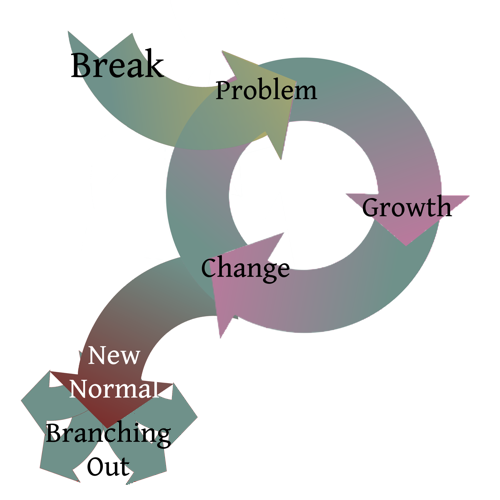
My plot structure is a cyclical one. There are six stages to it, with three stages making up the central cycle.

Upper left arrow labeled ‘Break’ points into the ‘Problem’ step of a three-step cycle – ‘Problem’, ‘Growth’, and ‘Change’. Lower left arrow, the ‘New Normal’, branches off from the third step, ‘Change’. Several smaller arros labeled ‘Branching Out’ extend from ‘New Normal’. The diagram illustrates the steps of a growth-centered story structure with the first step being the ‘Break’ from normal and the final steps being the ‘New Normal’ and ‘Branching Out’ after an number of three-step cycles determined by the story being written.

Number of Acts: As many as needed

What is it?:

  1. Break with Normality
  2. Problem the characters can’t/don’t know how to deal with
  3. Growth
  4. Change in the situation/characters understanding of the situation
    1. repeat 2-4 as necessary until
  5. New Normal
  6. Branching out to help others grow

Story Driver(s): ?

Notes:

Some stories have a ‘central conflict’ in the sense that an outside force creates the ‘Break with Normality’ and continues to interfere in establishing a new normal. However a central conflict is not necessary. If one does exist, it may be resolved before, during, or after the establishment of a new normal. Or not resolve at all.

The Break

The first stage is the Break with Normality. Before the break, characters existed in a situation they have considered ‘Normal’. ‘Normal’ usually has some built in stability or homeostasis so characters know what to expect and how to deal with the situations they run into.

‘Normal’ isn’t necessarily a good or healthy situation. In Bound by His Oath, ‘Normal’ for Mildthryth was being under frequent attack by lordlings who sought to conquer her lands and force her into marriage. ‘Normal’ for Reimund was being one of those lordlings. In the upcoming A Smear of Blood, ‘Normal’ is the goddes and Called slowly dying out under the oppression of the monks. But ‘Normal’ can be a healthy, happy situation — at the beginning of Planting Life in a Dying City, ‘Normal is Lefeng looking forward to traveling with the family ey loves and eir upcoming marriage.

How do we define ‘Normal’ then? ‘Normal’ is a (more or less) straight line trajectory. The characters’ lives are moving in a certain direction and are expected to continue moving that way.

The Break creates a sudden change in trajectory, wrenching characters lives in a new direction.

There are several ways a Break can happen. A character may make a choice that creates a Break, as when Mildthryth chooses to offer vassalage and marriage to Reimund rather than trying to ransom him, creating the possibility for a new relationship. It may be chance, like in Planting Life in a Dying City, when the tsunami destroys Lefeng’s family and village. It may be that a character from outside ‘Normal’ enters the story — as Iberto does in A Smear of Blood when he literally crashes into the high altar.

Whatever it is that causes the Break, there is a clear before and after.

A Problem

If the before is ‘the Normal’ then the after is ‘a Problem.’

A Problem is a situation that the characters need to deal with and don’t know how to. A Problem may be a new problem, an old problem the characters have a new perspective on, or an existing problem that is new to these characters.

A Problem is the first stage of the cyclical part of the story. Which is why it is ‘A’ Problem and not ‘The’ Problem. There will be multiple Problems throughout the course of the story.

The existence of multiple Problems is the biggest difference between a Problem and the ‘Conflict’ in a conflict-centered story. Many (though not necessarily all) Problems /are/ conflicts. But in a conflict-centered story there is a single central conflict. In a cyclical growth-centered story there are many not-central Problems.

The first problem in Bound by His Oath is that if Reimund accepts Mildthryth’s offer, he will shame himself. This is a new problem, as during the Normal, he was a proud man who refused to act in a way he would consider shameful.

In A Smear of Blood, the first problem is that there are not enough priests. Specifically, it is Iberto realizing that there are not enough priests. There have not been enough priests for a very long time before Iberto arrived at the temple. The lack of priests was a key part of the Normal, in fact. What has changed is not the problem itself, but that after the Break Iberto can see the problem.

The most important thing about a Problem is that the characters existing way of dealing with things won’t work to fix it. Reimund cannot automatically reject the shame — not unless he is willing to condemn his friends and followers. Iberto has no idea how to even begin fixing the lack of priests. If the characters attempt to continue doing things the same way they always have, the problem will continue or get worse.

Growth

If the characters want to deal with their problem, they need to grow. They may grow emotionally in some fashion, learn a new technique or skill, or if it is an ensemble story the main characters may grow in numbers, recruiting new members or allies to fight with them. There are probably dozens of ways a character can grow in response to a Problem.

Reimund, in Bound by His Oath, grows emotionally when he chooses to accept the shame for the sake of his men. This resolves the current Problem and he and Mildthryth are able to move forward together.

Importantly, Growth is a response to a Problem, not necessarily a fix for it. In A Smear of Blood, Iberto had been content to train for his new role and do his goddess’ bidding. On learning about the lack of priests and how it affects the goddes, Iberto stops being passive. He makes the decision to act — to hunt down the reason for the lack of priests and do something about it.

This is Growth, but it is not Growth that will immediately fix the problem. The problem will remain and Iberto and his friends and allies will spend most of the story addressing it in one way or another. That’s okay.

If Growth doesn’t fix a Problem, what’s its purpose in the story? Well, Growth leads to Change.

A Change

A Change is the new situation the characters find themselves in after after they grow. The last time I wrote about my story structure I called this stage ‘temporary stability.’ I’ve changed it because whether or not the situation is stable for any period of time has more to do with how fast the story is moving than the way the plot develops.

Like Growth, a Change can take several different forms.

In Bound by His Oath, after Reimund swears his loyalty to Mildthryth, she and all her people stop treating him as a prisoner and begin treating him as her betrothed. This is a Change in how the characters interact with each other.

Iberto, in A Smear of Blood, sees a different kind of change. Because he sets himself his own hunt for the first time, he begins to learn things. Most importantly, he learns that the monks are actively working against the goddes. This is a Change in perspective. A Change in how he understands the situation he finds himself in.

For Iberto, this leads to a new Problem, or new understanding of an old problem — there are not enough priests because potential priests aren’t coming to the temple where they can be recruited.

The Cycle

For a while, each Change will lead to a new Problem. Which leads to more Growth, another Change, a new Problem, etc.

The relationship in Bound by His Oath faces another problem when Reimund refuses to accept his new position and seeks to undermine Mildthryth, this leads to more growth, more change, more problems. Each turn of the cycle sees the characters and their situation growing/changing further and further from their original Normal.

A New Normal

Eventually, a Change will come with doesn’t lead to a new Problem. The characters and situation have changed enough, grown enough, that whatever problems they are facing are no long a Problem – that is, the characters have learned how to cope with and/or fix these problems and no longer NEED to grow in order to cope with them. The cycle is broken. The characters settle into a New Normal. Their lives are moving in a different direction then they were before the Break, but they are again moving ‘forward’ in a stable fashion.

This doesn’t necessarily mean that all their problems are solved. Life doesn’t work that way, and stories don’t need to either. What it means is that the characters have grown enough, and the situation has changed enough, that the characters are confident in their ability to handle the problems they are facing.

Branching Out

Characters who have grown to the point of being secure in a New Normal and who care about other people will want to spread that security. The final point of our story is the beginning of someone else’s story — when the characters reach out to help other characters. Sometimes that help will Break the other character’s Normal, it might provide guidance or resources for someone else’s Growth or Change, or something else.

Branching Out will usually come at the end of the story, but sometimes, for various reasons, it may come earlier. Planting Life in a Dying City is broken into six parts, one part focusing on each of the main characters. In the second part, the character Tsouchm instigates the Branching Out after one of eir Growth stages. Tsouchm’s life has improved considerably in the early part of eir story section, and ey wants to share that improvement with eir old friends, a desire the other family members support and aid.

So Far, It All Fits

I previously said that there are four things that make a growth-centered story:

  1. The plot can be defined in terms of growth.
  2. The story cannot happen without significant character growth.
  3. The story doesn’t need an antagonist, and if there is one the protagonists are not focused on them.
  4. The protagonist’s growth and actions affect the world around them/the wider community.

What I’ve outlined here for my growth-centered plot structure includes all four. Well, at least three of the four. We didn’t really talk about characters at all. The lack of an necessary antagonist can probably be inferred from the story structure, but I didn’t actually address point three here.

Growth-Centered Story Structures

  1. Growth Centered Story-Structure
  2. What Makes a Growth Centered Story?
  3. My Cyclical Growth-Centered Story Structure

How can relationships successfully deal with the issue of grudging consent?

Note: This is based on an answer I wrote on Quora a number of years ago. The original question was from a monogamous person grudgingly agreeing to a polyamorous relationship, but my response resonated with people in a variety of circumstances. It was one of my popular Quora answers, as well as one of the most personally meaningful.

I’m going to take a stab at this. On the one hand, I agree with many folks who say that grudging consent is not consent. On the other hand, I am in a relationship where resentment and grudgingly dealing with shit is a regular part of our day. Not because of polyamory but because of disability. So I have a slightly different perspective on relationships that include resentment and grudging going-along-with than most people.

So, some background. My partner was not disabled when we entered a relationship together. They were working, had some ongoing health problems. While we had the normal ups and downs, we did okay.

They became disabled over a year, gradually getting worse, then suddenly getting worse, getting better for a little while then getting worse again. We’ve worked hard to keep our relationship going, but it’s been a struggle. I can’t leave them alone with the baby, which means I NEVER go anywhere without the baby. Half the time they can’t wash their own hair, so I need to wash their hair for them. And there are only so many times a day you can be asked to interrupt what you are doing to get someone else a drink before it starts to grate on you.

We’ve been together for about 7 years now. Their health has varied a great deal over that period: including one hospitalization, numerous ER trips, and brief periods when they’ve been able to put their cane away, watch the kid while I worked a night job, or help with the housework.

I love them, I am happy to be in a relationship with them, and I resent the hell out of their disability and the demands it makes of me every fucking day.

Obviously, every relationship is different. As I always say: take what is useful, ignore what is not.

Every day you choose. This is the most important thing of all relationships—every day you choose to be in that relationship. You didn’t say “yes” once, and that was the end of it. Every day you either choose “I’m in this relationship and I’m going to make it work,” or you choose “I can’t/won’t/don’t want to make this work anymore.” Sometimes you need to say “I’m in this relationship, but I need to take care of myself today, so I’m going to step back and will get back in the harness of making this relationship work tomorrow.” That’s okay. But every day you choose. If everyone involved in a relationship says every day, “I’m going to make this relationship work,” the relationship can last through just about anything.

If the relationship stops being healthy for you, it’s time to choose to stop making it work. Don’t force a relationship to work at the expense of your own health and well-being.

Focus on the good things. Living with and taking care of a disabled partner is its own kind of hell. Especially when you don’t have a diagnosis and have no idea if your partner is suffering from a chronic condition or if they are dying and you don’t even know it. You can’t think about it too much, or you will drive yourself crazy. Similarly, a mono partner in mono/poly can’t focus on dates and fears that their poly partner will “find someone better” or other negatives of mono/poly. Focus on the good in your relationship. (Etc for other kinds of relationships.)
(They make me laugh. No one ever made me laugh like this before. They understand me, my depression, my anxiety, my PTSD, and they accept all of it. And they try. Always, they try to do better and be better. Some days, I’m afraid they’ll break themself trying but better, so much better, that they try than that they give up.)

Find ways to adapt. How does disability (poly) change your relationship? How can you change your routines and expectations to work with, rather than against, those changes?

Trust. I need to trust that my partner is doing everything he can. That when they tell me they can’t get to the kitchen to get themself a glass of water, they really are in that much pain. That when they say they can’t wash their hair, they really can’t reach their arms over their head. A mono partner needs to trust that when their poly partner says, “I love you and I won’t leave you,” they mean it. That a poly partner who says “Having sex with someone else doesn’t change how I feel about you,” is telling the truth. The mono partner may not understand how their poly partner can feel this way, but they need to trust that it is true. (Etc for other kinds of relationships.)

I never consented to life with disability. I live with my partner’s disability grudgingly, resentfully, and sometimes painfully. But I love my partner, we are good together, and to be with them I put up with their disability. We talk about it. I cry on their shoulder about how I resent it and how much it demands of me, and they don’t blame me or get defensive because they understand. Sometimes they cry on my shoulder about how they hate hurting me, how they feel like I should leave them and be with someone better because I deserve more. And I hold them and tell them I love them, and being with them is worth all this and more.

I can’t tell you how to turn grudging consent into acceptance. I’m still trying to find the trick to that myself. But I hope this helps.

Just remember, every day you choose. And if there is often something to be celebrated in choosing to continue a difficult relationship, there is no shame in deciding that you can’t anymore. We can only give so much without harming ourselves, after all.

Personal update: I wrote this answer over 8 years ago, and a lot has happened since then. I mentioned in this answer that we didn’t have a diagnosis and so didn’t know if my partner was dealing with a chronic condition or something life-threatening. It turned out to be a whole constellation of different problems: some chronic, some treatable. One of the treatable ones was life-threatening, but since it was treatable, that’s not a concern anymore (thank god!) They are still disabled, and so am I now, but we are still choosing each other every day.