On Queer Fiction

Queer is both a adjective and a verb. One can be a queer person, and one can queer shit up. To queer is hard to define — as hard to define as ‘kink’ and ‘love’ — but inherent in any working definition of ‘to queer’ must be ‘to fuck with the status quo.’

If you aren’t shaking shit up, you aren’t queering it. If you aren’t fucking with people’s expectations and overturning world views, you aren’t queering.

There is lots of lgbt+ fiction. There is far less queer fiction. To be queer fiction, it is not enough to have queer characters. To be queer fiction, the story must also queer. A story may queer expectations of romance and relationships, or ideas about society, or genre tropes. It may challenge the current societal status quo or propose an entirely new worldview. Perhaps all of these at the same time.

I write queer fiction. Mostly spec fic — fantasy and sci-fi. Mostly found family. Often kinky. But to the extent I can manage, always queer. What I love most is queering ideas about love and family but sometimes I’ll get a kick out of queering tropes, or ideas about how society can work, or even classical literature.

It isn’t always comfortable to read (or write). But it is always mine.

Queerly yours,
Jess

Note: I know some people view ‘queer’ as a slur and don’t want it to be used. If you do not like my positive use of ‘queer,’ then you dislike my fucking with the status quo of how you understand the word ‘queer.’

If that’s a problem for you, maybe think about why.

My Cyclical Growth-Centered Story Structure
A couple years ago I wrote and posted a couple of essays about growth-centered story structures. Growth-centered story structures have existed for a long time, but have been ignored or forgotten in the emphasis on the conflict-centered 5-act story structure.

If you haven’t yet, you should definitely check out Worldwide Story Structures by Kim Yoonmi. It’s a wonderful introduction to the variety of story structures around the world, and will really help you begin to understand the full palette available to us as writers, beyond the 5-act plot.

My own growth-centered story structure is the result of trial and error over about a decade, as I jettisoned the centrality of conflicted and focused on writing the kind of stories I wanted, regardless of if they were ‘right’. Everything I write about my story structure is me trying to describe something no one has ever described before, and which may not have existed before I created it.

When I wrote the previous essays, I was just beginning to analyze and understand how my stories, and other growth-centered writing, work. I wouldn’t say I’ve figured it out yet, but I’m definitely getting a better handle on things.

With that in mind, one thing I’ve figured out is a better way of describing and understanding how my particular kind of growth-centered plot works.

So let’s take a look at it.

Cyclical Growth Plot

Here I am borrowing Kim Yoonmi’s format for analyzing a plot structure.

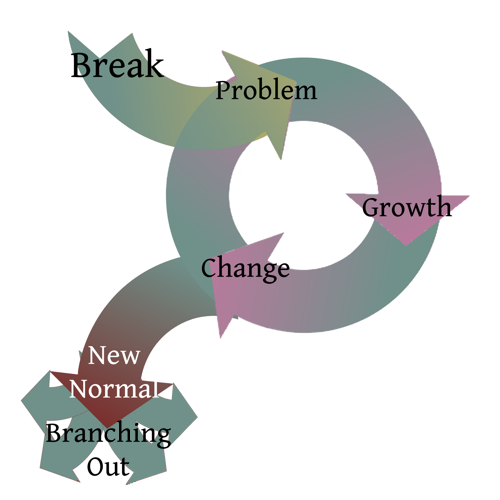
My plot structure is a cyclical one. There are six stages to it, with three stages making up the central cycle.

Upper left arrow labeled ‘Break’ points into the ‘Problem’ step of a three-step cycle – ‘Problem’, ‘Growth’, and ‘Change’. Lower left arrow, the ‘New Normal’, branches off from the third step, ‘Change’. Several smaller arros labeled ‘Branching Out’ extend from ‘New Normal’. The diagram illustrates the steps of a growth-centered story structure with the first step being the ‘Break’ from normal and the final steps being the ‘New Normal’ and ‘Branching Out’ after an number of three-step cycles determined by the story being written.

Number of Acts: As many as needed

What is it?:

  1. Break with Normality
  2. Problem the characters can’t/don’t know how to deal with
  3. Growth
  4. Change in the situation/characters understanding of the situation
    1. repeat 2-4 as necessary until
  5. New Normal
  6. Branching out to help others grow

Story Driver(s): ?

Notes:

Some stories have a ‘central conflict’ in the sense that an outside force creates the ‘Break with Normality’ and continues to interfere in establishing a new normal. However a central conflict is not necessary. If one does exist, it may be resolved before, during, or after the establishment of a new normal. Or not resolve at all.

The Break

The first stage is the Break with Normality. Before the break, characters existed in a situation they have considered ‘Normal’. ‘Normal’ usually has some built in stability or homeostasis so characters know what to expect and how to deal with the situations they run into.

‘Normal’ isn’t necessarily a good or healthy situation. In Bound by His Oath, ‘Normal’ for Mildthryth was being under frequent attack by lordlings who sought to conquer her lands and force her into marriage. ‘Normal’ for Reimund was being one of those lordlings. In the upcoming A Smear of Blood, ‘Normal’ is the goddes and Called slowly dying out under the oppression of the monks. But ‘Normal’ can be a healthy, happy situation — at the beginning of Planting Life in a Dying City, ‘Normal is Lefeng looking forward to traveling with the family ey loves and eir upcoming marriage.

How do we define ‘Normal’ then? ‘Normal’ is a (more or less) straight line trajectory. The characters’ lives are moving in a certain direction and are expected to continue moving that way.

The Break creates a sudden change in trajectory, wrenching characters lives in a new direction.

There are several ways a Break can happen. A character may make a choice that creates a Break, as when Mildthryth chooses to offer vassalage and marriage to Reimund rather than trying to ransom him, creating the possibility for a new relationship. It may be chance, like in Planting Life in a Dying City, when the tsunami destroys Lefeng’s family and village. It may be that a character from outside ‘Normal’ enters the story — as Iberto does in A Smear of Blood when he literally crashes into the high altar.

Whatever it is that causes the Break, there is a clear before and after.

A Problem

If the before is ‘the Normal’ then the after is ‘a Problem.’

A Problem is a situation that the characters need to deal with and don’t know how to. A Problem may be a new problem, an old problem the characters have a new perspective on, or an existing problem that is new to these characters.

A Problem is the first stage of the cyclical part of the story. Which is why it is ‘A’ Problem and not ‘The’ Problem. There will be multiple Problems throughout the course of the story.

The existence of multiple Problems is the biggest difference between a Problem and the ‘Conflict’ in a conflict-centered story. Many (though not necessarily all) Problems /are/ conflicts. But in a conflict-centered story there is a single central conflict. In a cyclical growth-centered story there are many not-central Problems.

The first problem in Bound by His Oath is that if Reimund accepts Mildthryth’s offer, he will shame himself. This is a new problem, as during the Normal, he was a proud man who refused to act in a way he would consider shameful.

In A Smear of Blood, the first problem is that there are not enough priests. Specifically, it is Iberto realizing that there are not enough priests. There have not been enough priests for a very long time before Iberto arrived at the temple. The lack of priests was a key part of the Normal, in fact. What has changed is not the problem itself, but that after the Break Iberto can see the problem.

The most important thing about a Problem is that the characters existing way of dealing with things won’t work to fix it. Reimund cannot automatically reject the shame — not unless he is willing to condemn his friends and followers. Iberto has no idea how to even begin fixing the lack of priests. If the characters attempt to continue doing things the same way they always have, the problem will continue or get worse.

Growth

If the characters want to deal with their problem, they need to grow. They may grow emotionally in some fashion, learn a new technique or skill, or if it is an ensemble story the main characters may grow in numbers, recruiting new members or allies to fight with them. There are probably dozens of ways a character can grow in response to a Problem.

Reimund, in Bound by His Oath, grows emotionally when he chooses to accept the shame for the sake of his men. This resolves the current Problem and he and Mildthryth are able to move forward together.

Importantly, Growth is a response to a Problem, not necessarily a fix for it. In A Smear of Blood, Iberto had been content to train for his new role and do his goddess’ bidding. On learning about the lack of priests and how it affects the goddes, Iberto stops being passive. He makes the decision to act — to hunt down the reason for the lack of priests and do something about it.

This is Growth, but it is not Growth that will immediately fix the problem. The problem will remain and Iberto and his friends and allies will spend most of the story addressing it in one way or another. That’s okay.

If Growth doesn’t fix a Problem, what’s its purpose in the story? Well, Growth leads to Change.

A Change

A Change is the new situation the characters find themselves in after after they grow. The last time I wrote about my story structure I called this stage ‘temporary stability.’ I’ve changed it because whether or not the situation is stable for any period of time has more to do with how fast the story is moving than the way the plot develops.

Like Growth, a Change can take several different forms.

In Bound by His Oath, after Reimund swears his loyalty to Mildthryth, she and all her people stop treating him as a prisoner and begin treating him as her betrothed. This is a Change in how the characters interact with each other.

Iberto, in A Smear of Blood, sees a different kind of change. Because he sets himself his own hunt for the first time, he begins to learn things. Most importantly, he learns that the monks are actively working against the goddes. This is a Change in perspective. A Change in how he understands the situation he finds himself in.

For Iberto, this leads to a new Problem, or new understanding of an old problem — there are not enough priests because potential priests aren’t coming to the temple where they can be recruited.

The Cycle

For a while, each Change will lead to a new Problem. Which leads to more Growth, another Change, a new Problem, etc.

The relationship in Bound by His Oath faces another problem when Reimund refuses to accept his new position and seeks to undermine Mildthryth, this leads to more growth, more change, more problems. Each turn of the cycle sees the characters and their situation growing/changing further and further from their original Normal.

A New Normal

Eventually, a Change will come with doesn’t lead to a new Problem. The characters and situation have changed enough, grown enough, that whatever problems they are facing are no long a Problem – that is, the characters have learned how to cope with and/or fix these problems and no longer NEED to grow in order to cope with them. The cycle is broken. The characters settle into a New Normal. Their lives are moving in a different direction then they were before the Break, but they are again moving ‘forward’ in a stable fashion.

This doesn’t necessarily mean that all their problems are solved. Life doesn’t work that way, and stories don’t need to either. What it means is that the characters have grown enough, and the situation has changed enough, that the characters are confident in their ability to handle the problems they are facing.

Branching Out

Characters who have grown to the point of being secure in a New Normal and who care about other people will want to spread that security. The final point of our story is the beginning of someone else’s story — when the characters reach out to help other characters. Sometimes that help will Break the other character’s Normal, it might provide guidance or resources for someone else’s Growth or Change, or something else.

Branching Out will usually come at the end of the story, but sometimes, for various reasons, it may come earlier. Planting Life in a Dying City is broken into six parts, one part focusing on each of the main characters. In the second part, the character Tsouchm instigates the Branching Out after one of eir Growth stages. Tsouchm’s life has improved considerably in the early part of eir story section, and ey wants to share that improvement with eir old friends, a desire the other family members support and aid.

So Far, It All Fits

I previously said that there are four things that make a growth-centered story:

  1. The plot can be defined in terms of growth.
  2. The story cannot happen without significant character growth.
  3. The story doesn’t need an antagonist, and if there is one the protagonists are not focused on them.
  4. The protagonist’s growth and actions affect the world around them/the wider community.

What I’ve outlined here for my growth-centered plot structure includes all four. Well, at least three of the four. We didn’t really talk about characters at all. The lack of an necessary antagonist can probably be inferred from the story structure, but I didn’t actually address point three here.

Next week, I’ll share some of my thoughts on characters in a cyclical growth-centered story and take a closer look at point three.

Growth-Centered Story Structures

  1. Growth Centered Story-Structure
  2. What Makes a Growth Centered Story?
  3. My Cyclical Growth-Centered Story Structure
Lună’s Vision: Coming Feb 15

Book cover. (Mostly) white text on dark blue background. “Book 2 of Clan Lună” at top. “Lună’s Vision” with “Lună” in red and “Vision” in white above an image of a half moon. “Jess Mahler” at the bottom. Image is framed on two sides by decorative scrollwork.

A month ago I was alone.
My mother was dead, my clan scattered. Now I have my mates, a former mercenary team who didn’t know vampires existed before they met me. We had a rough start, but we’re working together now. Which is good, because my enemies found me. Luckily, Lună was looking out for us.
We’re in hiding now, trying to plan our next move, and figuring out how we all fit together. But before we can make our move, our enemies make theirs.
Just when I thought I could finally get laid.
Lună’s Vision is a slow burn paranormal romance and the second in a series about Natalia of the Lună vampires, her five mates, and the future they will build together. Contains FF, MM, and FMF relationships. No AI.

Find it on Smashwords, Itch and other booksellers.

Meadowsweet

Central image is a sleek, almost triangular spaceship flying in a starry void. Image is surrounded by a black oval on a brick red background. Text: ‘Meadowsweet’ above and ‘Jess Mahler’ below the central image

Anonymous post to the Galactic AITA

I’m the captain of a small trading ship, and I have a problem.

I have a ridiculously high sex drive thanks to that damn parasite from Verda, and I can’t afford surgery to remove it. I tried to control it, but I nearly destroyed my crew a dozen times before I found something that worked: A sex slave.

I buy a slave from people who are going to work her to death, give her good quarters, good food, and a percentage of each trading run. All I expect is that she be available for sex, mostly with me, sometimes with the crew. A lot.

I’ve had 3 so far. Two saved enough to buy themselves free and got a nice set up on the world of their choice. The third kept trying to escape so I ditched her at our next planetfall with the clothes on her back. We’re on our way to a so-called ‘Personnel Processing Platform’ to buy the next one.

Am I the Asshole?

Content warning: This is essentially a heavy non-consent/dubious consent story set in space. If you are uncomfortable with noncon, explicit sex and/or rape, or fictional slavery, this story isn’t for you. No AI

On Smashwords.

Dracula and the Wolfman?

Book cover, everything in shades of yellow-orange. A smiling face with beard look out at the viewer from the left side of the image. Text "Dracula and the Wolfman?" and "Jess Mahler"

If anyone finds out what Nick and Daniel get up to in their spare time, there will be hell to pay.

Vampires and werewolves have been on the edge of war for generations. They aren’t supposed to be friends. They certainly aren’t supposed to be dating. And the idea of them submitting to each other would horrify even the most broad minded of their families.

But as long as no one knows, they can enjoy their kinky lives to their hearts’ content. Right?

This M/M short story features pet play, vampire and werewolf switches, explicit sex, and a curious witch.

Now available

The Last Lady of Lună

Book cover. (Mostly) white text on dark blue background. “The Last Lady of Lună” with “Lună” in red overlaying the image of a crescent moon. “Jess Mahler” at the bottom. Image is framed on two sides by decorative scrollwork.

I was a child when enemies destroyed our clan. 

My mother escaped and raised me in secret. Without my fathers’ blood, she aged and died. Now I am the last head of Clan Lună. My enemies think I am dead, my clan is scattered to the winds, and I am just coming into my powers. I will claim my birthright, rebuild my clan, and destroy our enemies. I’m just going to need a bit of help.

Luckily I know where to find it. A hot team of human mercenaries specializing in security is looking for their next job. They’re exactly what I need. Now I just need to convince them to believe me, keep my secrets, and rain hell on my enemies.

And if Lună is still watching out for me, maybe I’ll finally get laid.

The Last Lady of Lună is a slow burn paranormal romance and the first in a series about Natalia of the Lună vampires, her five mates, and the future they will build together. Contains FF, MM, and FMF relationships. No AI.

Now available for on most retailers: https://books2read.com/u/m0LQYW

His New Master

Left cover is image of a man with dark hair and goatee wearing glasses. On the right is text, "Jess Mahler" in the top cover and "His New Master in bottom corner. Background is orange gradient.

Sold into slavery to pay his parents debts, Sam is happy with his kind mistress and predictable life. Until the day his mistress tells him he’s been sold… with no information on the person who now owns him, not even a name, Sam faces an uncertain and unknown future with His New Master.

A short mm fantasy romance of fresh starts and a massive mind f*ck.

Available on most retailers.

What Makes a Growth Centered Story?

Growth-centered stories are a relatively new idea for me, and I’m still exploring all the different facets of what they are and how they work. Today I want to explore what makes a growth-centered story and how it’s different from other stories.

So today, we’re going to take a look at that.

As always, I’m figuring this out as I go and I’m sure I’m missing some stuff.

For this discussion, I’m using Andre Norton’s Hands of Lyr as an example. The Hands of Lyr and the other Senses stories have a central conflict which is critical to the plot. But the stories are not centered on that conflict; they are centered on growth. As a story that walks the line between conflict- and growth-centered, I think The Hands of Lyr is a good choice to identify what makes a growth-centered story and how it is different from conflict-centered even when there is significant conflict. Expect major spoilers.

Several things make up a growth-centered story. Here’s my current take (subject to evolution and change):

  1. The plot can be defined in terms of growth.
  2. The story cannot happen without significant character growth.
  3. The story doesn’t need an antagonist, and if there is one the protagonists are not focused on them.
  4. The protagonist’s growth and actions affect the world around them/the wider community.

Destroy the Binary — it’s not just growth or conflict

I’m focusing on the line between growth and conflict-centered stories because most English stories are conflict-centered. But not all stories are one or the other. I mentioned in another essay LeGuin’s story Those Who Walk Away from Omelas as a Carrier Bag story that is not growth-centered. In fact, it rejects even the idea of growth, pointedly saying that none of the characters seek or achieve change. They only either accept or reject the horror their seeming utopia hides.

Defining the Plot — the one line summary

The first requirement of a growth-centered story is that the story can be defined in terms of growth. The one-line summary is probably the most common way to define a plot.

If Andre Norton used one-line summaries for her stories, I’ve never seen them. But if I were to write a logline for The Hands of Lyr, it would go something like this:

A priestess-in-training and a priest-hating warrior must learn to work together to find and restore a sacred relic and save a broken land.

There are several other ways you could put together a one-line summary. Still, I can’t think of any I’d write that doesn’t include the need for Alnosha and Kryn to learn to work together. Learning to work together is a form of growth.

So, this story can be defined in terms of growth.

Now, it is possible to define this story in terms of conflict. For instance:

A priestess-in-training and an embittered warrior must work together to defeat an ancient evil poisoning the land.

This summary is less accurate (and we’ll see why later), but it’s a workable summary for this story.

Some growth stories can be defined in terms of conflict, but that doesn’t make them not growth-centered. The important thing is that they /can/ be defined — accurately — in terms of growth.

The Story Cannot Happen without Significant Character Growth

This… almost goes without saying, right? You can’t have a growth-centered story without growth. This growth may take different forms, but it has to be there.

It Does Not Need an Antagonist

Many growth-centered stories don’t have an antagonist or a central conflict to overcome. Instead, they may have a series of small conflicts the protagonist must navigate or have other types of challenges.

If there is an antagonist —

The Protagonist Is Not Focused on the Antagonist

Just because there is an antagonist doesn’t mean that the protagonist is focused on them. Sometimes, you have a “I am your greatest rival!” “I didn’t know I had a rival” moment. The antagonist is obsessed with the protagonist, and the protagonist just… didn’t know they existed. Or they might know about the antagonist but consider the antagonist a ‘later’ problem while they try to focus on this other thing.

Or, as in The Hands of Lyr, the antagonist may be interfering with another quest.

Nosh’s goal in The Hands of Lyr is to reassemble the titular Hands of her goddess. Kryn gets dragged into her quest, initially unwillingly. This quest is a threat to the antagonist — the evil wizard who broke the Hands nearly a century ago. Having the Hands reassembled will be a major threat to his power in the world. But —

If the evil wizard got struck with lightning a few chapters into the book, the story would still have happened and had the same basic plot.

Nosh and Kryn would still have traveled across the land seeking the scattered Fingers. They still would have faced raiders, criminal lords, and blizzards. Kryn would still have needed to confront himself and his goals and accept that he had become a new person and his old goals did not fit the person he became. Nosh would still need to learn how to interact with people and function in society after being raised in total isolation by the last priestess of Lyr.

Now, the evil wizard doesn’t get hit by lightning a few chapters in. He is a threat throughout the entire story up until the final confrontation. But the main characters, when they become aware of him, are aware of him not as the goal but as an /impediment/ to restoring the Hands and, with them, the land once ruled by Lyr.

Even in the final confrontation, we see this. When Nosh and Kryn reach the statue, they find the evil wizard left a spell which threatens the Hands and the wizard himself slowly manifesting in the room.

Instead of a big climactic battle, Nosh /ignores/ him. That’s her big challenge: ignoring the big bad and his threatening magic while she restores the fingers. To trust in herself, her goddess, and Kryn at her back. And Kryn, who does confronts the evil wizard, defeats the big bad not by attacking /him/, but by attacking the magic cord that ties him to the spell.

The evil wizard is, as far as the world is concerned, the big bad. He broke the world, destroyed the old order, and laid waste to entire countries. But as an antagonist, he is a distraction. It is by not being drawn into a confrontation that Nosh and Kryn win the day — because the wizard may fill the role of an antagonist, but he is not their focus.

Their focus is on healing and restoration, not conflict.

The Protagonist’s Growth and Actions Impact the Wider Community (Maybe)

I’m not sure about this one, but it’s a pattern I am seeing. Growth-centered stories generally focus on the growth of the protagonist, but growth does not happen in isolation. The growth of the protagonist will impact the world around them. If all change is internal, it is not true growth.


It’s been over six months since I first wrote this and posted it on my old website. Maybe over a year, I kind of lost track in there. Reading it over now, I’m pretty happy with it. I think this is a good litmus test for what is and is not a growth-centered story.

What do you think? Drop a comment and let me know!

Growth-Centered Story Structures

  1. Growth Centered Story-Structure
  2. What Makes a Growth Centered Story?
  3. My Cyclical Growth-Centered Story Structure
A Cousin’s Blood

The ritual was simple, as all new rituals are. It was based on an older tradition – one that long ago ceased to be simple, but retained a simple core.

Teach them to your children.

Rachel and Chana prepared while the children gathered around. The grandparents waited in the background, eyes shining as they remembered the early years when they had prepared so, the fear and the hope and the promise to do what must be done.

“Why is this day different from other days?” asked Nathan. He was twelve that year, about to be b’mitzvah and take on responsibility for his own actions. The next year, if he chose, he could begin training to join his parents when he turned eighteen.

“How is this day different?” Chana responded.

“Most days, we go out together, but today you leave your children home.”

“Today, we go where it may not be safe,” Chana said as she checked the balance of her shield.

“How is this day different?” Rachel asked.

“Other days, you go out for dressed peace; today, you go out dressed for fighting.”

“Other days, we go out for our own reasons; today, we go out to guard our cousins.” As Rachel spoke, she locked her phone in a portable Faraday cage and packed it in her emergency medical bag.

“Why do we guard our cousins today?” asked Yiska, the youngest.

Rachel and Chana paused their preparations in surprise. Yiska did not have part in this ritual, she was too young. But the question was right and the answer was important.

Chana knelt down and chucked Yiska’s chin. “God commands that we are responsible for our siblings. We must never stand by while our siblings’ blood is spilled.

“Our cousins are not siblings, but they are still family. God surely did not mean for us to guard our siblings and ignore our cousins. So we guard them when they need it. And they guard us when we do.”

It was an idea centuries old, born of the Blood Libel and the pogroms, when the Jews of Europe’s ghettos needed to always be ready to defend themselves. Today it was repurposed for a new age. Across the city, but especially in homes clustered around the city’s synagogues, people prepared riot shields and bullhorns, medicine and bandages.

No one remembered who began the tradition or even what city it started in. Perhaps it had begun in many places at once, as needed things sometimes do. But in every city and town where the cousins lived side by side, the practice was honored and cherished.

Rachel and Chana finished preparing and the family ended the ritual with song, because all holy days must have songs. They sang new songs to go with the new ritual. We will build this world with love, the song said, and God will build this world with love.

Then Rachel and Chana thanked their parents for watching the children, and left. As they stepped out the door, they murmured a brucha. “Blessed are You, Lord our God, ruler of the Universe, who has commanded us to protect our family.”

As the call to prayer went out across cell phones and radios, they came. Some in kippah or tichel or snood, others bare-headed, the Hebraic Community Defense teams gathered around the mosques of the city. None came barehanded. Inside, their cousins would pray in peace, undisturbed by whatever the day might bring.

The guardians expected a quiet day. Their cousins would share their feast and they would spend the time exchanging news of family and friends, making plans for the new year, and even playing games. But still, they would watch, and when their cousins finished praying and emerged, the guardians would greet them with a song. All holy days must have songs.

Tomorrow night, as the shofar rang out across the city, the Islamic Community Defense teams, in keffiyeh or hijab or neither, would stand guard over the synagogues.

It had been 20 years and more since the last major attack on a house of worship. The most they guarded against today was petty vandalism and hecklers. But still, for each holy day, they gathered. Still, they taught their children why.

Lest a cousin’s blood be spilled.


I wrote this the summer of ’23, for a market requesting visions of a better future. Ironic considering how much worse the near future actually was. But no matter how bad things get, they can always get better. May a better future come soon for all of us.